The Back-to-School Budget AI Builds for You
AI back-to-school budget planning itemizes every cost — supplies, clothes, tech, fees — so you stop underestimating August spending.
The beta is open — hand this off to Jipsa. Free to start, no card required.
Sign Up for BetaBack-to-school shopping feels manageable in theory. A few notebooks, some pencils, a new backpack. Then the supply lists arrive, the shoe sizes have changed, the laptop needs replacing, three activity registration deadlines hit the same week, and suddenly you have spent $1,100 per child without a plan. AI back-to-school budget planning makes the full number visible before you spend the first dollar.
The surprise is not the spending. It is the gap between what you expected and what actually happens.
Where Back-to-School Budgets Go Wrong
The Visible vs. Invisible Costs
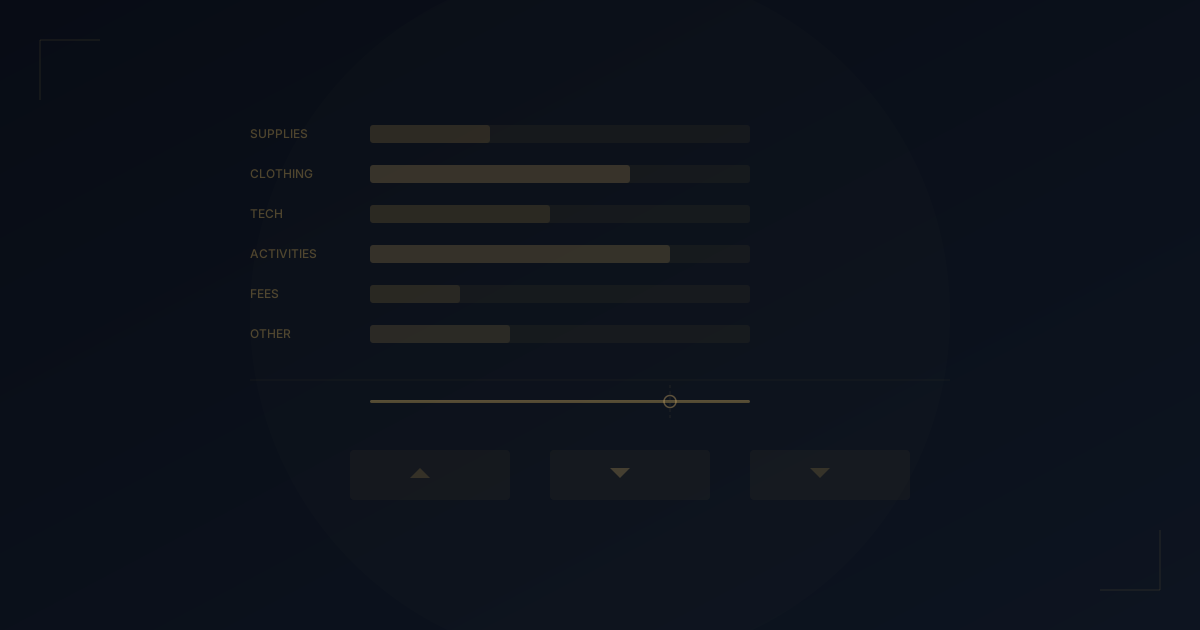
Parents budget for the obvious: school supplies and a few new outfits. But back-to-school spending has at least six cost categories, and most families only plan for two:
- School supplies. The list from the teacher — notebooks, folders, markers, calculator. $50-150 per child.
- Clothing and shoes. Growing kids need new sizes every year. $200-400 per child.
- Technology. Laptop, tablet, headphones, chargers, software subscriptions. $100-500 depending on the year.
- Activity and sports fees. Registration for fall sports, music lessons, after-school clubs. $100-600 per child.
- School fees. Lunch account deposits, transportation fees, PTA dues, yearbook pre-orders. $50-200 per child.
- Miscellaneous. Haircuts, new lunchboxes, water bottles, room decor for older kids. $50-150 per child.
Add it up and the real number is $800-1,200 per child. For families with two or three kids, back-to-school spending rivals a vacation budget — but without the vacation.
The Timing Problem
Back-to-school costs do not arrive on a single invoice. They trickle in across six weeks. The supply list in late July. The sports registration email in early August. The "we need a graphing calculator" text the first week of school. The picture day envelope in September.
By the time you realize you have overspent, the spending is done. AI solves this by front-loading the budget before the spending begins.
How AI Builds a Complete Back-to-School Budget
Inventory What You Already Have
Before buying anything, AI helps you audit what is already in the house. Last year's backpack might have another year in it. The colored pencils from spring are barely used. The laptop is still functional even if it is not the newest model.
AI builds a checklist against the supply list and your existing inventory:
- Items you already own and do not need to replace
- Items that need replacing (worn out, wrong size, broken)
- Items that are genuinely new requirements
- Items where last year's version is acceptable vs. where an upgrade makes sense
Most families can eliminate 20-30 percent of their back-to-school shopping list by doing this inventory step first. Without AI prompting the audit, most people skip straight to buying.
Categorize and Estimate Every Cost
AI takes the school supply lists, last year's spending data, and your family's specific needs, then builds a comprehensive line-item budget:
| Category | Estimated Cost | Notes | |---|---|---| | Supplies (Child 1) | $85 | Per teacher supply list | | Supplies (Child 2) | $110 | Per teacher supply list | | Clothing | $350 | Both kids, based on growth and wardrobe gaps | | Shoes | $120 | Two pairs each (school + athletic) | | Technology | $75 | New headphones, charger replacement | | Activity fees | $340 | Soccer ($180) + art class ($160) | | School fees | $125 | Lunch deposits + transportation | | Miscellaneous | $95 | Haircuts, lunchboxes, water bottles | | Total | $1,300 | |
Seeing $1,300 in August is better than discovering it across your credit card statements in October.
Find Savings Without Cutting Corners
AI does not just itemize costs — it identifies where the savings are:
- Price comparison. The same 24-pack of glue sticks costs $4.99 at one store and $8.99 at another. AI checks prices across retailers.
- Timing optimization. Back-to-school sales peak in late July and again in the tax-free shopping weekend (if your state has one). AI maps purchases to the best sale windows.
- Bundle opportunities. Some retailers offer supply bundles pre-packaged by grade level that cost less than buying items individually.
- Hand-me-down coordination. For families with multiple kids, AI tracks which items from the older child can pass to the younger one next year.
- Generic vs. brand. Where brand does not matter (notebooks, folders, erasers), AI defaults to the generic option. Where it does matter (a specific calculator model), it finds the best price on the exact item.
Typical savings from AI-optimized back-to-school shopping: 15-25 percent off the unoptimized total.
Managing the Budget in Real Time
Track Against the Plan
Once the budget is set, AI tracks actual spending against each category as purchases happen. Overspend on clothing? AI shows you the remaining budget across other categories and suggests where to adjust.
This is not about restriction — it is about visibility. You can decide to spend more on quality shoes and less on supplies. The point is that you make that trade-off consciously, not by accident.
Handle the Mid-September Surprises
The budget does not end on the first day of school. September brings its own costs:
- The teacher's "additional supplies needed" email
- Picture day fees
- Field trip costs
- The sudden need for a specific gym uniform nobody mentioned in August
AI reserves a contingency buffer — typically 10-15 percent of the total budget — for exactly these surprises. When they arrive, they come out of the buffer instead of the grocery budget.
The Multi-Child Multiplier
Families with multiple children face exponential complexity. Different grade levels mean different supply lists. Different growth rates mean different clothing needs. Different activities mean different fee structures.
AI manages each child's back-to-school budget independently while showing you the consolidated family total. You can see that Child 1's school year startup costs $750 and Child 2's costs $550, and that the family total of $1,300 fits within your planned spending — or does not, and needs adjustment before the purchases start.
For families already using AI to manage their household budget, back-to-school spending integrates directly into the existing financial picture rather than living as a separate, untracked expense.
Start the Budget Before the Supply Lists Arrive
Supply lists typically arrive in late July or early August. But you can start the budget weeks earlier. Most back-to-school costs are predictable: you know your kids will need clothes, you know fall activities will have fees, you know technology will need maintenance or replacement.
AI builds a preliminary budget from last year's spending and your family profile, then refines it once the specific supply lists arrive. By the time you walk into the store, you know exactly what you are buying, where you are buying it, and what it should cost.
Back-to-school spending does not have to be a financial surprise. Jipsa builds the budget, tracks the spending, and finds the savings — so September starts without the credit card hangover.
Let Jipsa handle it for you
The beta is open. Create your account and hand off the logistics of everyday life — free to start, no card required.
Sign Up for BetaFree Download
The AI Home Management Checklist
42 tasks AI can handle for your household — from meal planning to home maintenance. See exactly what to automate first.