The End of Decision Fatigue: Let AI Handle the Details
Decision fatigue silently drains your productivity. Learn how AI delegation eliminates cognitive overload by automating the small choices you make daily.

The beta is open — hand this off to Jipsa. Free to start, no card required.
Sign Up for BetaYou have probably experienced it without knowing its name. By mid-afternoon, choosing what to have for lunch feels impossibly hard. By evening, the idea of deciding on a restaurant, planning tomorrow's schedule, or figuring out what groceries you need feels like an unreasonable demand on a brain that has already been working all day. This is decision fatigue, and it is one of the most pervasive yet invisible drains on modern productivity.
Understanding Decision Fatigue
Decision fatigue is the deterioration of decision-making quality after a long session of making decisions. The term was coined by social psychologist Roy Baumeister, whose research demonstrated that willpower and decision-making draw from the same finite mental resource. Every choice you make -- no matter how trivial -- depletes that resource.
The numbers are staggering. Researchers estimate that the average adult makes approximately 35,000 decisions per day. The vast majority are small: what to wear, which route to take, what to eat, whether to respond to an email now or later, which brand of pasta to buy. Individually, none of these decisions matter much. Collectively, they create an enormous cognitive load.
The Hidden Cost
Decision fatigue does not announce itself. You do not suddenly feel a sharp pain when your decision-making capacity runs out. Instead, you experience it as:
- Impulsive choices: Grabbing whatever is easiest rather than what is best
- Decision avoidance: Putting off choices entirely, letting emails pile up, ignoring tasks
- Reduced willpower: Struggling to maintain healthy habits, exercise routines, or budgets
- Lower quality thinking: Making worse decisions on things that actually matter -- career moves, financial planning, relationships
A landmark study on Israeli parole judges found that favorable parole decisions dropped from 65% to nearly 0% as judges progressed through decision-heavy sessions -- then spiked back up after a break. The decisions themselves had not changed. The judges' capacity to make them had been depleted.
Why Traditional Productivity Advice Falls Short
Most productivity advice focuses on doing things faster or organizing tasks better. Time-blocking, to-do lists, prioritization frameworks -- these are valuable tools, but they miss a critical dimension. They optimize the tasks without reducing the decisions.
A to-do list tells you what to do, but you still have to decide when to do it, how to do it, and whether the priority has shifted since you wrote it down. A meal plan template tells you to plan your meals on Sunday, but you still face dozens of decisions about what to cook, what to buy, and where to shop.
The real breakthrough is not better organization. It is fewer decisions. Understanding how AI handles the mental load of daily life is key to seeing why delegation works where willpower alone cannot.
The AI Delegation Model
This is where AI fundamentally changes the equation. Not by making you more efficient at deciding, but by removing decisions from your plate entirely.
What Can Be Delegated
Not every decision should be automated. The goal is to identify the high-volume, low-stakes decisions that consume disproportionate mental energy and delegate those to AI. These fall into clear categories:
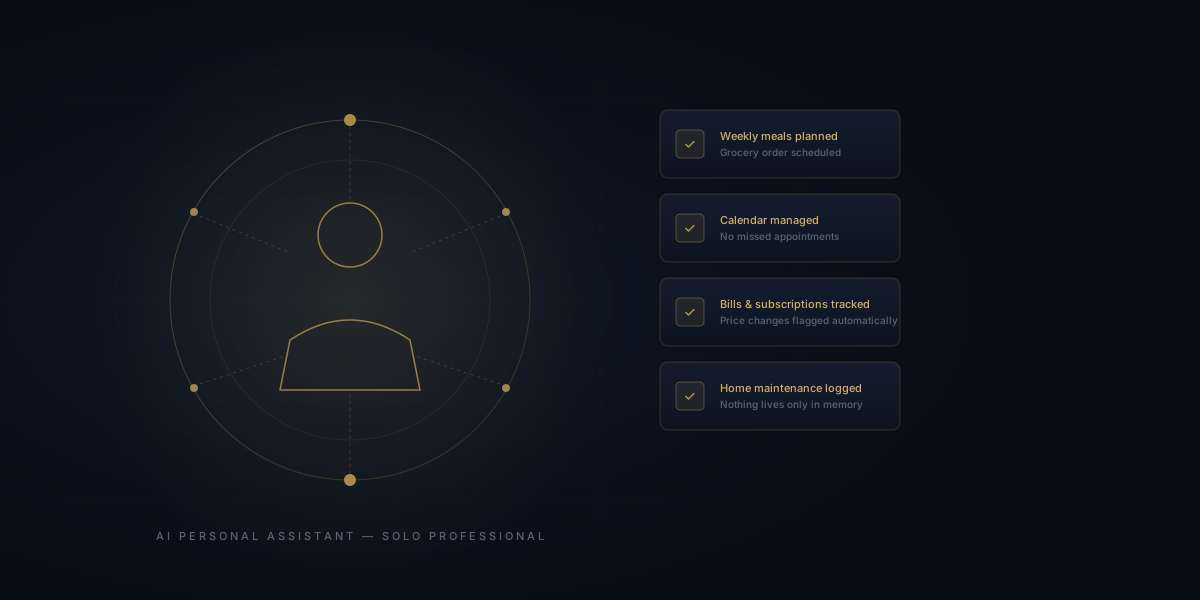
Meal logistics: What to eat, what to buy, when to cook, and where to order from. These decisions recur daily, involve multiple variables, and rarely benefit from deep human deliberation. An AI butler handles the entire chain.
Scheduling: When to book appointments, how to arrange your calendar around priorities, when to set reminders. Calendar management is a decision-dense task that AI handles naturally by understanding your constraints and preferences.
Shopping: Which products to buy, which are on sale, which store has the best price, whether you already have something at home. This is pattern-matching and optimization -- exactly what AI excels at.
Reservations and bookings: Where to eat, what time works, how to accommodate preferences and restrictions. These decisions involve cross-referencing multiple data sources, which is tedious for humans and trivial for AI.
Routine coordination: When to reorder household supplies, when to schedule recurring tasks, how to plan around upcoming events. These are maintenance decisions that do not require creativity or judgment -- just consistency.
What Should Stay Human
The decisions worth keeping are the ones that involve values, creativity, relationships, and strategy. Choosing a career direction, deciding how to spend quality time with your family, navigating a complex interpersonal situation, setting long-term goals -- these benefit from human judgment, emotional intelligence, and personal values that AI cannot replicate.
The irony is that by delegating the small decisions, you actually make better big decisions. Your cognitive resources are preserved for the moments that matter.
The Mental Health Dimension
Decision fatigue is not just a productivity problem. It is a well-being problem. Research consistently links chronic cognitive overload to:
- Elevated stress hormones: Decision-making activates the prefrontal cortex, which under sustained load triggers cortisol production
- Sleep disruption: An overloaded mind struggles to wind down, leading to racing thoughts and poor sleep quality
- Anxiety: The accumulated weight of unmade decisions -- the mental backlog -- generates background anxiety that persists even during rest
- Burnout: Decision fatigue compounds over weeks and months, contributing to the chronic exhaustion characteristic of burnout
By automating routine decisions, AI delegation reduces the total cognitive load your brain processes each day. The effect is not dramatic on any single day, but over weeks, users consistently report feeling less stressed, sleeping better, and having more mental clarity for the things they care about.
How Jipsa Implements AI Delegation
Jipsa is built specifically around the delegation model. It is not a tool that helps you make decisions faster -- it is a system that makes decisions for you, within parameters you define.
Here is how that works in practice:
You set the boundaries: Dietary preferences, budget limits, schedule constraints, cuisine preferences, favorite stores. These are the guardrails within which Jipsa operates.
Jipsa handles the rest: Meal plans are generated, grocery orders are placed, reservations are booked, and calendar events are created. You receive a summary of what was done and can adjust anything, but the default is that the work is complete.
The system learns: Every adjustment you make, every meal you rate, every suggestion you override teaches Jipsa your preferences more precisely. Over time, the need for adjustments decreases because the system increasingly anticipates what you would choose.
This is not about losing control. It is about choosing where to invest your attention. You remain in charge of the decisions that matter while Jipsa handles the thousands of micro-decisions that would otherwise drain your energy throughout the day.
Reclaiming Your Mental Bandwidth
Decision fatigue is not a character flaw. It is a biological reality. Your brain has a finite capacity for decisions each day, and modern life demands far more decisions than any previous generation faced. The solution is not willpower -- it is architecture.
By designing your daily life so that routine decisions are handled automatically, you preserve your mental energy for the decisions that define the quality of your life. AI makes this possible at a scale and precision that was not available even five years ago.
Jipsa is your starting point. Let it handle the details, and discover what you can do with a mind that is not spent on deciding what to have for dinner.
Let Jipsa handle it for you
The beta is open. Create your account and hand off the logistics of everyday life — free to start, no card required.
Sign Up for BetaFree Download
The AI Home Management Checklist
42 tasks AI can handle for your household — from meal planning to home maintenance. See exactly what to automate first.