Is a Personal AI Butler Worth It? A Cost-Benefit Breakdown
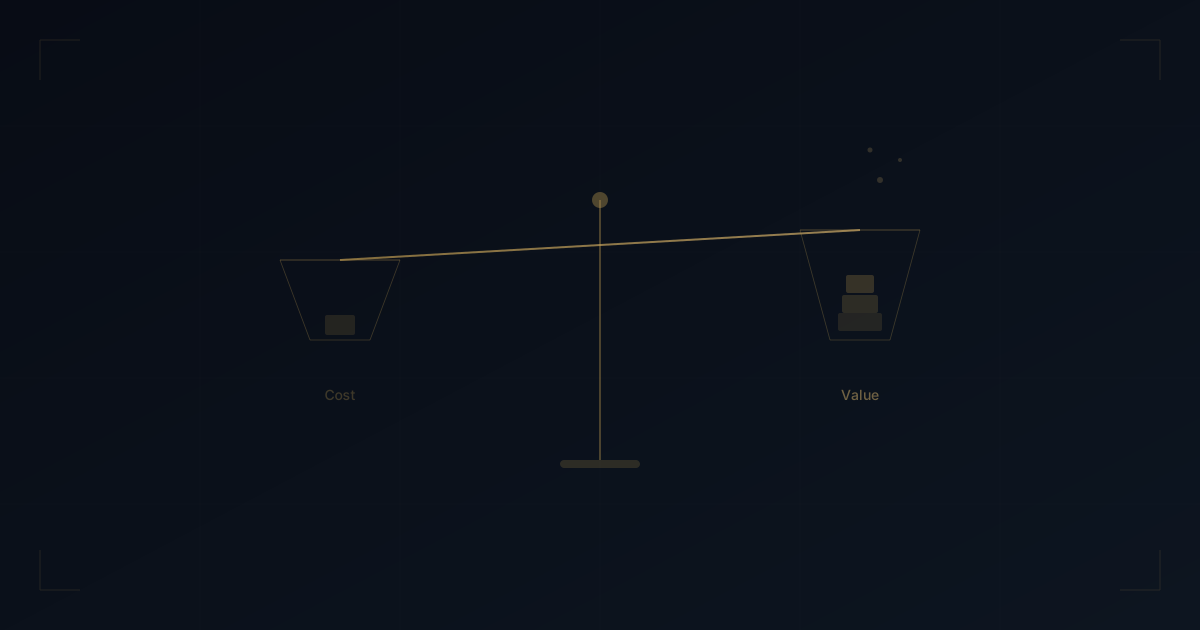
What does a personal AI butler actually save you? An honest cost-benefit analysis of Jipsa — measured in dollars, hours, and decisions per week.
The beta is open — hand this off to Jipsa. Free to start, no card required.
Sign Up for BetaIs a personal AI butler worth it? The honest answer depends on how you value your time, how much invisible work your household generates, and whether you have ever calculated the true cost of managing daily logistics yourself. Most people have not. The numbers are surprising.
Here is the cost-benefit breakdown -- not in vague promises, but in the actual dollars, hours, and decisions that Jipsa moves off your plate.
The Time Cost of Running a Household
The American Time Use Survey and multiple time-tracking studies converge on a consistent finding: the average dual-income household spends 15-20 hours per week on household management tasks. This includes:
- Meal planning and grocery shopping: 4-6 hours/week
- Cooking logistics and prep: 3-5 hours/week
- Calendar coordination and scheduling: 2-3 hours/week
- Home maintenance research and scheduling: 1-2 hours/week
- Financial admin (bills, subscriptions, budgeting): 1-2 hours/week
- Miscellaneous logistics (returns, errands, research): 2-3 hours/week
These are not leisure activities. They are operational overhead -- the hidden cost of running a household that does not appear on any invoice.
If you earn $75,000 per year, your effective hourly rate is roughly $36/hour. At 15 hours per week of household logistics, you are spending the equivalent of $540/week -- over $28,000 per year -- of your productive capacity on tasks that follow repeatable patterns an AI can learn.
What Jipsa Saves: The Dollar Breakdown
Direct Time Savings
Jipsa automates the highest-time-cost activities in household management. Based on what the system handles in a typical week:
| Task | Manual Time | With Jipsa | Weekly Savings | |---|---|---|---| | Meal planning | 1.5 hrs | 0 (automated) | 1.5 hrs | | Grocery list + ordering | 2 hrs | 0 (automated) | 2 hrs | | Morning planning/triage | 1.5 hrs | 5 min (review briefing) | 1.4 hrs | | Event/date research | 1.5 hrs | 5 min (review suggestions) | 1.4 hrs | | Schedule coordination | 1 hr | 15 min (review conflicts) | 0.75 hrs | | Maintenance tracking | 0.5 hr | 0 (automated) | 0.5 hrs | | Total | 8 hrs | 0.4 hrs | ~7.5 hrs/week |
That is roughly 7.5 hours per week returned to you. At a $36/hour effective rate, that is $270/week or $14,000/year in reclaimed productive time.
Reduced Food Waste
The USDA estimates American households throw away $1,500 worth of food annually. The primary driver is poor planning -- buying ingredients without a plan, forgetting what is in the pantry, and cooking portions that do not match actual need.
Jipsa's meal planning is built on pantry awareness and portion precision. It plans meals around what you have, orders only what you need, and adjusts quantities to your household size. Conservative estimate: a 40% reduction in food waste saves $600/year.
Smarter Grocery Spending
When you shop without a precise list, impulse purchases add 20-30% to your grocery bill (Marketing Science Institute data). Jipsa generates exact grocery lists from exact meal plans. No wandering the aisles. No "might as well grab this." No duplicate purchases because you forgot what was already in the pantry.
For a household spending $800/month on groceries, a 15% reduction from disciplined, AI-generated shopping saves $1,440/year.
Subscription Cleanup
The average American household has 12 active subscriptions and pays for 2-3 they have forgotten about or no longer use. At an average of $15/month per forgotten subscription, that is $360-$540/year in waste.
Jipsa tracks every subscription, flags upcoming renewals, and identifies services you are paying for but not using. One-time savings from cleanup: $300-500. Ongoing savings from vigilance: prevents future subscription creep.
Late Fee and Missed Appointment Avoidance
Forgotten appointments, missed free-trial deadlines, and late payments add up. The average household loses $200-400/year to the "forgetting tax" -- small charges that accumulate because no system was tracking them.
Jipsa's proactive tracking eliminates this category entirely. Conservative savings: $250/year.
Total Annual Value
| Category | Annual Savings | |---|---| | Time reclaimed (7.5 hrs/week at $36/hr) | $14,040 | | Reduced food waste | $600 | | Smarter grocery spending | $1,440 | | Subscription cleanup | $400 | | Forgetting tax elimination | $250 | | Total | $16,730/year |
Even if you discount the time savings by half (maybe you would have spent those hours on Netflix, not billable work), the financial value alone -- food waste, grocery efficiency, subscription management, and fee avoidance -- adds up to $2,690/year in hard dollar savings.
The Decision Cost Nobody Calculates
Beyond time and money, there is a third cost: decisions. Research on decision fatigue shows that the average person makes 35,000 decisions per day. Hundreds of those are household logistics -- what to eat, when to shop, which brand to buy, whether to reschedule, what needs restocking.
Each decision consumes a small amount of cognitive energy. By 3pm, most people are running on fumes -- not because their work was hard, but because they spent their decision-making capacity on trivial logistics before lunch.
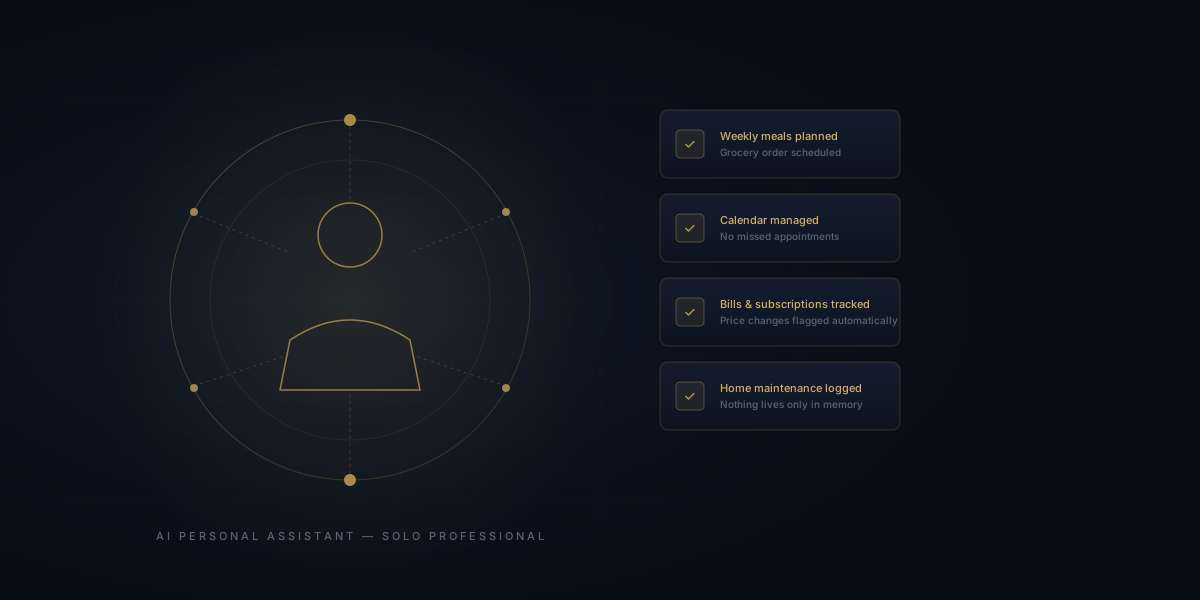
Jipsa removes hundreds of daily decisions from your plate. The meal plan is decided. The groceries are ordered. The schedule is coordinated. The maintenance is tracked. You do not need willpower or organizational skills. You need a system that handles the decisions you never wanted to make.
The value of this is hard to quantify in dollars. But anyone who has experienced the difference between a day where everything was handled and a day where nothing was planned knows exactly what it is worth.
The Comparison: Jipsa vs. Alternatives
Vs. Doing It Yourself
You already know the cost -- 15-20 hours/week and the mental load that comes with it. For a detailed comparison, the math is clear: DIY household management is the most expensive option when you account for your time.
Vs. Hiring Help
A personal assistant costs $25-50/hour. A meal planning service runs $10-20/week for plans only -- no execution. A house manager is $50,000-80,000/year. These services work, but they are priced for households with significant discretionary income.
Jipsa delivers comparable outcomes at a fraction of the cost because software scales in ways human labor cannot.
Vs. Productivity Apps
You could assemble a stack: Mealime for meals, Todoist for tasks, Google Calendar for scheduling, Mint for finances. Total cost might be low, but the integration burden falls on you. You are the glue between siloed tools, manually transferring context between apps that do not talk to each other.
Jipsa replaces the stack with a single system that reasons across every domain.
Who Should Not Get a Personal AI Butler
Transparency matters. Jipsa is not for everyone.
If you genuinely enjoy meal planning, grocery shopping, and the process of managing your household -- if it brings you satisfaction rather than stress -- Jipsa removes something you value. Some people find peace in these routines. That is valid.
If you live alone, have minimal scheduling complexity, and your weekly logistics total 3-4 hours, the value proposition is thinner. Jipsa saves the most time for households with the most operational complexity.
If you are not comfortable with AI systems taking action on your behalf -- even with full transparency and control settings -- the trust gap will limit your experience.
Who Should
If you have ever said any of the following, Jipsa was built for you:
- "I do not have time to figure out what is for dinner every night."
- "Managing this household is a second job."
- "I forgot to cancel that subscription again."
- "We need to be better about grocery planning."
- "I just want someone to handle this."
A personal AI butler is worth it when the cost of not having one is measured in time you cannot get back, money you did not mean to spend, and energy you would rather direct toward the parts of life that actually matter.
Jipsa handles the rest. Here is how it works.
Let Jipsa handle it for you
The beta is open. Create your account and hand off the logistics of everyday life — free to start, no card required.
Sign Up for BetaFree Download
The AI Home Management Checklist
42 tasks AI can handle for your household — from meal planning to home maintenance. See exactly what to automate first.