The Psychology of Outsourcing: Why Delegation Wins
High performers delegate ruthlessly because cognitive science says it makes them sharper. Here is the research behind outsourcing tasks to AI for productivity.

The beta is open — hand this off to Jipsa. Free to start, no card required.
Sign Up for BetaThere is a persistent myth that the most successful people are the ones who do everything themselves. The self-made entrepreneur grinding eighteen-hour days. The executive who answers every email personally. The parent who handles every detail of the household without help.
In reality, the research shows the opposite. High performers are distinguished not by how much they do, but by how ruthlessly they eliminate tasks that do not require their unique abilities. They delegate. They outsource. They automate. And the cognitive science explains exactly why this makes them better at everything they keep.
The Cognitive Bandwidth Model
Your brain has a finite amount of processing power each day. Psychologists call this "cognitive bandwidth," and it works remarkably like RAM in a computer. Every task you hold in working memory -- from remembering to buy milk to preparing for a high-stakes presentation -- occupies a portion of that bandwidth.
In a landmark 2013 study published in Science, researchers Sendhil Mullainathan and Eldar Shafir demonstrated that cognitive load from mundane concerns measurably reduces IQ and executive function. Participants who were preoccupied with routine logistical problems performed significantly worse on cognitive tests -- equivalent to losing 13 IQ points.
Thirteen points. That is the difference between normal cognitive function and being too impaired to perform at your best. And it was not caused by stress or anxiety. It was caused simply by having too many things occupying mental bandwidth.
Every grocery list you maintain, every appointment you track, every meal you plan -- each one takes a small slice of bandwidth. Individually, they seem trivial. Collectively, they degrade your ability to think clearly about the things that actually matter.
Why High Performers Delegate Ruthlessly
Warren Buffett famously said, "The difference between successful people and really successful people is that really successful people say no to almost everything." But it is not just about saying no to opportunities. It is about saying no to tasks.
Tim Ferriss popularized the concept in The 4-Hour Work Week, but the principle is much older. Every effective leader throughout history has understood that their value lies not in doing tasks, but in making decisions that only they can make. Everything else should be handled by someone -- or something -- else.
The psychological mechanism behind this is well-documented:
Ego depletion. Every decision you make draws from a limited daily pool of willpower and decision-making energy. Research by Roy Baumeister showed that people who make many small decisions early in the day make worse decisions later. Delegating small decisions preserves your capacity for big ones. This is precisely the problem explored in the end of decision fatigue — and why automating routine choices produces such an outsized improvement in daily life.
Attention residue. When you switch between tasks, a portion of your attention stays stuck on the previous task. Professor Sophie Leroy at the University of Minnesota found that this "attention residue" significantly reduces performance on the next task. Fewer tasks means less switching, which means less residue.
The Zeigarnik Effect. Unfinished tasks occupy more mental space than completed ones. Your brain keeps an open loop for every incomplete item. If you have twenty household tasks lingering in the background, that is twenty open loops consuming bandwidth. Delegating them closes the loops.
The Guilt Problem
If the science is so clear, why do most people not delegate more? The answer is guilt.
We live in a culture that equates busyness with virtue. Admitting that you do not want to plan meals or track groceries feels like admitting weakness. Outsourcing household tasks triggers an internal narrative: "I should be able to handle this myself."
But this narrative does not survive contact with the evidence. Delegation is not a sign of inability. It is a sign of strategic thinking. Every hour you spend on a task someone -- or something -- else could handle is an hour you are choosing not to spend on something only you can do.
Consider the opportunity cost. If you spend five hours a week on meal planning, grocery shopping, and cooking logistics, those are five hours you are not spending on your career, your relationships, your health, or your personal growth. The question is not "Can I do this myself?" It is "Is this the best use of my limited time and cognitive energy?"
For almost every administrative and logistical task, the answer is no.
From Human Assistants to AI
Historically, delegation required hiring humans. Personal assistants, housekeepers, meal delivery services, bookkeepers. This created a financial barrier that limited delegation to the wealthy.
AI demolishes that barrier.
An AI assistant can handle the coordination layer of your life -- the planning, scheduling, optimizing, and tracking -- at a fraction of the cost of human help. More importantly, AI has advantages that human assistants do not:
No management overhead. Managing a human assistant is itself a task that requires bandwidth. You need to communicate preferences, provide feedback, handle scheduling, and deal with the inherent friction of human coordination. AI requires a brief setup period and then operates autonomously.
Perfect memory. AI does not forget that you hate cilantro, that your partner is allergic to shellfish, or that you always run out of paper towels on Thursdays. Every preference, pattern, and constraint is retained permanently.
24/7 availability. AI does not sleep, take vacations, or have bad days. Your morning briefing is ready when you wake up, your grocery order is optimized at 2 AM when prices update, and your dinner plan adapts in real time when your schedule changes.
No social friction. Many people feel uncomfortable telling another person what to do. They soften requests, avoid giving direct feedback, and tolerate suboptimal results to preserve the relationship. With AI, you can be perfectly direct. There is no social cost to saying "I did not like that suggestion, try again."
The Delegation Framework
Not every task should be delegated. The key is to distinguish between tasks that require your unique judgment and tasks that are purely operational. Here is a simple framework:
Keep: Anything that requires your unique creativity, relationships, expertise, or values-based judgment. Writing a novel. Having a conversation with your child. Making a strategic career decision. Choosing a gift for someone you love.
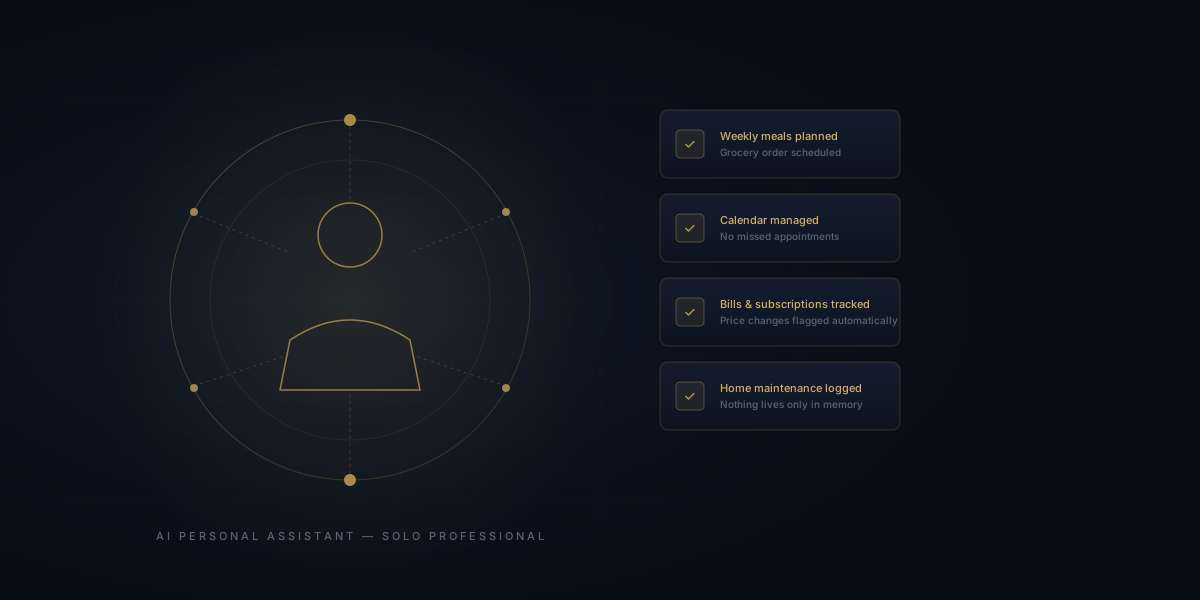
Delegate to AI: Anything that is repetitive, logistical, research-heavy, or optimization-based. Meal planning. Grocery price comparison. Calendar coordination. Bill tracking. Appointment scheduling. Daily briefings.
Eliminate: Anything that does not need to be done at all. Many tasks exist only because "we have always done them." Challenge whether each task actually creates value.
Most people find that 40-60% of their weekly tasks fall into the "delegate" category. That is not a small optimization. That is a fundamental restructuring of how you spend your time and energy.
The Compounding Returns of Delegation
The benefits of delegation compound over time. In the first week, you save a few hours. In the first month, you start to notice that you are less stressed, more focused, and making better decisions. By the third month, the habits you build with your reclaimed time -- exercising more, reading more, investing more in relationships -- begin to generate their own returns.
This is the flywheel effect. Delegation creates free time. Free time enables investment in high-value activities. High-value activities generate results that improve your life further. Better outcomes reduce stress. Lower stress improves cognitive function. Better cognitive function makes you even more effective.
The people who delegate are not just saving time. They are upgrading their entire operating system.
AI as the Ultimate Delegate
Jipsa was designed around the psychology of delegation. It is not another app that adds to your cognitive load. It is an AI butler that reduces it.
When you connect Jipsa to your daily services -- grocery delivery, calendar, restaurant reservations -- it takes over the coordination work that silently drains your bandwidth. It plans meals based on your preferences. It orders groceries at the best prices. It prepares your morning briefing. It books restaurants. It tracks the things you would otherwise have to hold in your head.
The result is not laziness. It is liberation. You get back the cognitive bandwidth to be fully present in your work, your relationships, and the moments that define your life.
The research is clear. The most effective people are not the ones who do everything. They are the ones who do only what matters and delegate the rest.
The question is not whether you can afford to delegate. It is whether you can afford not to.
Start delegating to Jipsa and reclaim your cognitive bandwidth.
Let Jipsa handle it for you
The beta is open. Create your account and hand off the logistics of everyday life — free to start, no card required.
Sign Up for BetaFree Download
The AI Home Management Checklist
42 tasks AI can handle for your household — from meal planning to home maintenance. See exactly what to automate first.