AI Personal Assistant Comparison: What Works in 2026
Siri, Alexa, ChatGPT, and Jipsa walk into your life. Only one of them actually does the work. Here is how AI personal assistants compare in 2026.
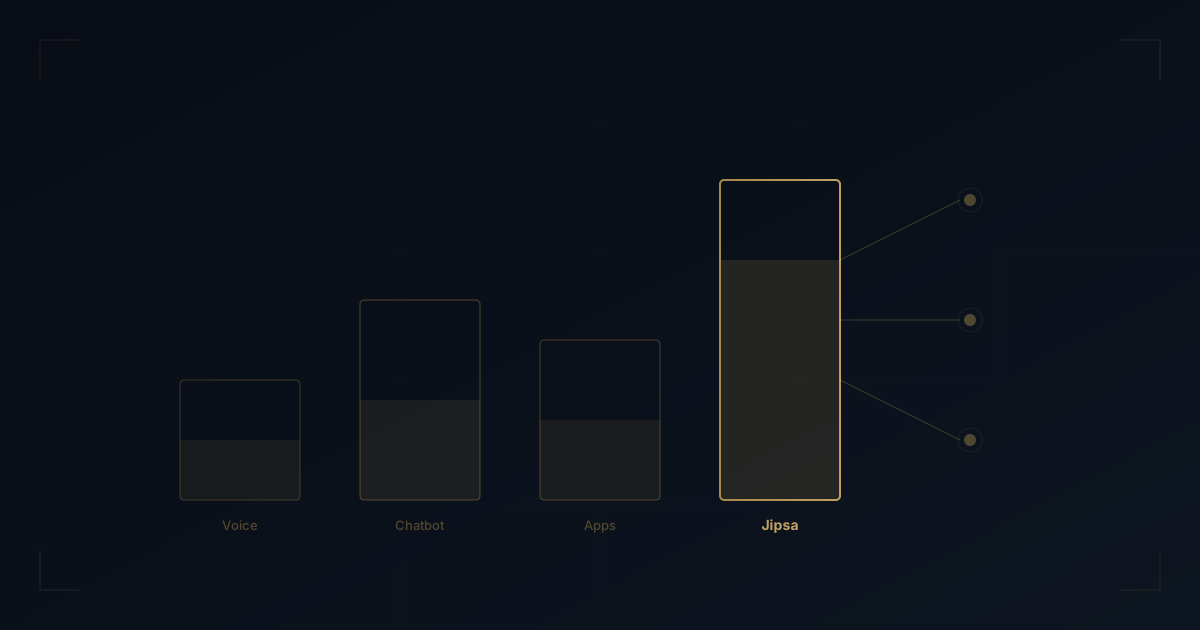
The AI personal assistant comparison in 2026 looks nothing like it did even two years ago. Voice assistants have plateaued. Chatbots have gotten smarter but remain reactive. And a new category -- AI agents that take real action on your behalf -- has emerged to fill the gap between "I can answer that" and "I already handled it."
If you are evaluating which AI assistant actually deserves a place in your daily life, here is an honest breakdown of what works, what does not, and where the market is heading.
The Four Categories of AI Assistants
Not all AI assistants are built for the same purpose. The confusion in the market comes from lumping fundamentally different products into the same bucket.
Voice Assistants: Siri, Alexa, Google Assistant
These were the first wave. They excel at simple, single-step commands: set a timer, play a song, turn off the lights. They are embedded in hardware ecosystems, which makes them convenient for device control but limited for anything requiring context or multi-step reasoning.
In 2026, voice assistants are essentially where they were in 2022. They understand you better, misfire less often, and integrate with more smart home devices. But ask Alexa to plan your meals for the week based on what is in your pantry while staying under budget, and you will get a search result, not a meal plan.
Best for: Smart home control, quick lookups, timers and alarms. Limitation: No persistent context. No multi-step task execution. No learning from your behavior.
AI Chatbots: ChatGPT, Claude, Gemini
The second wave brought conversational AI that can reason, write, analyze, and advise. These tools are remarkable for knowledge work -- drafting emails, summarizing documents, brainstorming ideas, coding. They represent a genuine leap in what machines can do with language.
But chatbots are fundamentally reactive. They respond when prompted. They do not connect to your grocery account. They do not know your calendar. They cannot book a restaurant or reorder your coffee. You can ask ChatGPT to create a meal plan, and it will -- a generic one that ignores your pantry, your family's preferences, and your Tuesday night time crunch.
Best for: Research, writing, analysis, brainstorming, coding. Limitation: No service integrations. No persistent memory of your life. Cannot take action in the real world.
Task-Specific Apps: Mealime, Todoist, IFTTT
The third category is specialized tools that do one thing well. Mealime plans meals. Todoist manages tasks. IFTTT chains automations. These apps are useful, but they operate in isolation. Your meal planner does not know about your calendar. Your task manager does not know about your grocery list. You become the integration layer, manually coordinating between apps that cannot talk to each other.
Best for: People who want control over a specific domain. Limitation: Siloed. Requires manual coordination. You are still the project manager.
AI Butlers: Jipsa
The fourth category is what happens when you combine the intelligence of a chatbot with real-world service integrations and persistent memory. This is where Jipsa operates.
An AI butler does not just answer questions or execute single commands. It connects to the services that run your household -- grocery delivery, calendars, local event platforms, smart home systems -- and manages them proactively. It learns your preferences over time. It reasons across domains. It takes action without being asked.
Best for: People who want the logistics of daily life handled, not just organized. Limitation: Newer category. Fewer providers. Requires trust in AI-driven execution.
Where Each Assistant Wins
The right AI assistant depends on what you are trying to accomplish. Here is the honest comparison.
Information Retrieval
If you need a quick answer to a factual question, chatbots win. ChatGPT and Claude are faster, more accurate, and more nuanced than any voice assistant or specialized app. Voice assistants are fine for basic queries but fall apart on anything complex.
Jipsa is not designed to be your search engine. It excels when the question is not "what" but "handle it."
Smart Home Control
Voice assistants still own this space. If you want to dim the lights or adjust the thermostat with your voice, Alexa and Google Home are purpose-built for it. Jipsa integrates with smart home devices but approaches home management from a higher level -- orchestrating systems rather than responding to individual commands.
Daily Life Management
This is where the gap becomes stark. Ask any chatbot, voice assistant, or task app to do what Jipsa does in a typical week:
- Generate a meal plan based on dietary preferences, pantry inventory, and this week's schedule
- Build a grocery list from that plan and place the order
- Surface local events that match your interests for the weekend
- Plan a date night with real venue suggestions and reservation options
- Deliver a morning briefing that synthesizes your day into actionable context
No other assistant category can execute this sequence end-to-end. Chatbots can draft parts of it. Voice assistants cannot even parse the request. Task apps would require five different tools and your manual coordination.
Knowledge Work
Chatbots dominate here and will continue to. If you need to draft a strategy document, analyze a dataset, or debug code, ChatGPT and Claude are the right tools. Jipsa is not competing in this space. It is competing in the space those tools ignore: the personal logistics that eat your evenings and weekends.
The Integration Problem No One Else Solves
The fundamental issue with every AI assistant except the butler category is the integration problem. Your life does not exist in one app. Your meals connect to your grocery budget. Your grocery budget connects to your calendar (no time to cook means more expensive prepared meals). Your calendar connects to your energy levels. Your energy levels connect to your meal planning.
These are not separate problems. They are one system. And the only way an AI assistant can manage that system is by connecting to all the services involved and reasoning across them.
Jipsa's cross-domain intelligence is not a feature. It is the architecture. When Jipsa plans your meals, it already knows what is on your calendar. When it suggests a date night, it already checked your budget. When it delivers your morning briefing, it has already coordinated the day across every connected service.
No amount of improvements to Siri or ChatGPT will replicate this without a fundamental shift in their architecture -- from responding to requests to managing your life.
The Trust Question
The most common objection to an AI butler is trust. Letting an AI place grocery orders, manage your calendar, and make suggestions about your evening sounds like a lot of autonomy.
Jipsa addresses this with granular control. You set the autonomy level for each category. Want to review every grocery order before it ships? Done. Comfortable letting Jipsa handle meal planning end-to-end? That works too. Every action is logged, every decision is explainable, and you can override anything.
This is fundamentally different from voice assistants, where Alexa might misinterpret "order more paper towels" and send you a case of 48 rolls. Jipsa shows you what it plans to do and why, and lets you decide how much independence to grant.
What to Choose Based on Your Needs
You want a quick-answer machine: Use ChatGPT or Claude. They are the best at information retrieval and knowledge work.
You want smart home voice control: Use Alexa or Google Home. They are mature, reliable, and purpose-built.
You want one specific task handled well: Use a specialized app. Mealime for meals. Todoist for tasks. They are focused and functional.
You want the logistics of your life managed: Use Jipsa. It is the only option that connects to your real services, learns your preferences, and takes action across every domain that consumes your time.
The Market Is Moving Toward Action
Every major AI company is talking about "agents" now. The language has shifted from "assistants that answer" to "agents that act." This is the direction the entire industry is heading, and it validates the AI butler category.
But there is a difference between a tech company bolting agent capabilities onto a chatbot and a product built from day one around real-world service integration. Jipsa was not a chatbot that learned to take action. It was designed to take action from the start.
The AI personal assistant comparison in 2026 comes down to one question: do you want an AI that talks to you, or one that works for you?
Jipsa works for you. That is the entire point.
Free Download
The AI Home Management Checklist
42 tasks AI can handle for your household — from meal planning to home maintenance. See exactly what to automate first.
Ready to let Jipsa handle this for you?
Join the waitlist — be first to get access when we launch.